
亞洲和太平洋地區(qū)的煤炭國際貿易研究
時間:2018-10-04 來源:51mbalunwen.com作者:lgg
本文是一篇國際貿易論文,國際貿易專業(yè)屬于經濟學學科范疇,主要以經濟學理論為依托,包括微觀經濟學、宏觀經濟學、國際經濟學、計量經濟學、世界經濟學概論、政治經濟學等。(以上內容來自百度百科)今天為大家推薦一篇國際貿易論文,供大家參考。
1 Introduction
1.1 General Background
For a long time now scholars have come to an agreement that coal is the mostimportant primary source of energy only after oil. The main use of coal as of now isthe generation of electricity and heat. According to the International Energy Agency,as of 2011, hard coal made up about 36% of all electricity generated in the world.Some of the major coal importing countries produces coal domestically; thesecountries include China, India, and the United States, thus making them bothproducers and importers. The international trade for Steam coal, which over the yearshas been produced and consumed within those countries, has recently been growingsignificantly. This is the result of rising demand from countries such as China. Thisrising international was briefly hampered by the shooting prices in 2007 and 2008when the whole trade experienced a shock.Coal plays an important role in the global energy mix, representing 29 percent oftotal primary energy demand in 2012, according to the International Energy Agency(IEA) World Energy Outlook 2014. While this percentage is expected to decline to 24percent in 2040, the IEA projects global coal demand will increase 15 percent by 2040.The fortunes of coal, however, differ dramatically by region. Coal demand declines inall OECD regions, particularly in the United States where a sharp reduction in coalfired electricity generation fell by nearly one third in the IEA s forecast, owing toincreased regulation and competition from other fuels, especially unconventional gasand renewable. Coal demand in developing countries, on the other hand, is expected toincrease by one third by 2040, with significant growth in Southeast Asia, India, Africa,and Brazil (China s coal demand is expected to peak in 2030)Experts on climate change have cited coal fired plants as the main and the biggestcontributor to the greenhouse gas emissions. For the year 2010 alone, a total of 7,228million tons of coal were produced by 61 countries whereas the consumption rising ashigh as 7238 million tons with the number of consuming countries reaching 104. Ofall these consumption, about 60% was channeled to power generation.
........
1.2 Energy and Trade
1.2.1 The need for energy trade in Asia
Since countries do not have equal endowments of resources, international tradebecomes inevitable to balance this inequality, energy resource is no exception. Somecountries have less energy resources than what their needs are. Whereas othercountries have more than their domestic coal needs. Energy is the single mostimportant resource which drives economies all around the world. Those countrieswhich rely on imported energy tend to be heavily dependent on import where at the same time those countries which export energy tend to rely on that export as theintegral part of their economic growth. Some energy resources such as coal are non-renewable, i.e. reserve is ever decreasing and thus posing a threat to the countrieswhich rely on it for their income generation.International Energy Agency reported in 2013 in its World Energy Outlook thatglobal trade in energy has made a shift to the Asia-Pacific region from the Atlanticmarket, the major reason was mentioned that countries in Europe and across theAtlantic have their economies self-sufficient when it comes to energy as compared tocountries in Asia which tend to rely on imports for their energy requirements.There are huge investment costs that are required if a country is to try andachieve energy self-sufficiency, generation of enough electricity, these costs includebuilding of infrastructures which cost a lot. Another challenge to this endeavor is thelack of latest technology to control for impacts of such investment on the environment.Even with this investment the world cannot be guaranteed of energy sufficiency sinceenergy needs are constantly on the rise. The one probably most sustainable way ofcurbing the problem of energy security is the adoption of new alternative sources ofenergy such as the solar power and wind power.
..........
2. Coal in the Asia-Pacific Market
2.1 A note on the structure of this Market
In recent years, the coal market in Asia has had a dynamic shift. China’s mainland, SouthKorea, Japan, and Taiwan of China are increasingly importing more and more quantities of coalto meet their demands for power generation and running their factories. Some thesecountries rely wholly on coal imports where as others such as China imports tosupplement its insufficient domestic production. On the supply side, two countriesAustralia and Indonesia have remained the dominant suppliers for years, even thoughthey are being faced with smaller emerging rivals such as South Africa and Colombia.The market structure for any market can be investigated either by mathematicalmodeling or by simply observing the behavior of the players. By employing the latermethod, the Asia pacific market is a non-perfect market since there are a few playerswhich seem to have a lion share, these players are China in the demand side andIndonesia and Australia in the supply side. China being the largest importer has stillyet to be able to determine the market price. Australia and Indonesia on the other handhave yet to become monopoly suppliers.Until 2012, more than 400 companies, mostly Chinese and Indian, had proposedto install new power projects all of which are coal fired, in China alone for examplethe so called“Big Five”energy companies i.e. Huaneng, Guodian, Huadian, ChinaPower Investment, and Datang, had submitted about 200 proposals to build new coalfired power plants. In India, the government owned developer of coal fired plants,NTPC, is in the race to submitting more proposals to build more projects.
.........
2.2 How important is Coal energy to Asian countries?
Coal is an indispensable source of electricity to some countries. It s mainly usedfor electricity generation, powering factories, and heat generation during cold seasons.Since most Asian countries experience winter seasons during the year, it s during thistime that most coal is burnt to heat homes and thus lead to air pollution.Some countries depend on coal exclusively for their electricity generation; thecountries under study are among the major coal dependents for that purpose. Sincesome of these countries are not self-sufficient in the supply of coal thus their importdemand goes up as the need for power goes up. Table below shows the dependencerate of some countries on imports of coal for electricity generation.From the table above, Taiwan of China has a 100% dependence on coal import out ofwhich 52.8% is used for its electricity generation. Taiwan of China being a small island has nocoal reserves, and no other means of energy thus it has entirely relied on coal importedfrom abroad to fire its power generating plants. Japan follows closely with 99.5%dependence on coal import, with 24.4% being used for generating electricity, makingit another desperate user of coal energy. South Korea has yet another greaterdependence on coal Import of 95.4% out of which 33.5% is directed to generatingelectricity. China follows last with 11% dependence ratio and only 8.6% of it goes toelectricity generation. China has this low figure because it has a massive reserve of itsown coal, so much of its power is generated from that stock and only a portion fromimported coal is channeled to generating power, most imported coal is used for heatinghomes during winter seasons. In the following sections I will presents the trends ofcoal sector in each country under study.
.......
3 Literature Review .... 43
3.1 The increasing role of coal in the power sector ............43
3.2 Development of Equilibrium models..........44
3.3 State of the literature........46
3.4 Chapter summary....48
4 Research Methodology ..... 49
4.1 The Model for Coal..........49
4.1.1 Coal Market Model for Asia and the Pacific ....49
4.2 Spatial Equilibrium Models (SEM) ............49
4.3 Influence of economic size on the volume of Coal trade......53
4.4 Data and sources of data...........55
4.5 Scope of study.........57
4.6 Data analysis...........57
4.7 Work flow......57
4.8 Organization of the thesis .........58
4.9 Work Flow Chart ....58
5 Findings and Discussions........... 61
5.1 Supply Curves.........61
5.2 Demand Curves.......63
5.3 Constant Terms.......64
5.4 Summary Results for Least Square Estimations (OLS).........65
5 Findings and Discussions
This section presents equilibrium quantities and prices for each country for eachyear as calculated using GAMS, E-views, and Gretl softwares. The table presentedbelow will indicate the quantities that were to be traded among countries under studyif all of them were to operate under equilibrium state factoring in the transport costbetween them.
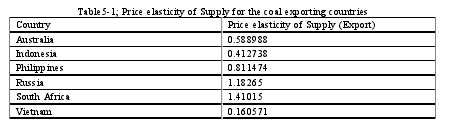
5.1 Supply Curves
The elasticity of supply shows the degree of responsiveness of supply to pricechanges in the world market. Some countries have exhibited a higher elasticity thanothers, this is a common trend in all markets not only energy market.The Least Square Method of Linear Regression was employed to obtain theelasticity which in turn was used for calculating equilibrium values. Gretl softwarewas used to run the regression analysis.The table above indicates the elasticities for exports of coal. The positive valuesindicate that countries export more coal when the price goes up, this is a commonresult and it s in line with the prediction of the economic theory of demand and supply.Indonesia has an elasticity of 0.412738 indicating that for every 1 percent increase inprice of coal in the market, Indonesia tends to increase its export by 0.4. Increase inexport is not equal to price increase since there are many players in the market all ofwhich are fighting to increase their export as a result of price increase.
........
Conclusions
In this thesis, I detailed supply and demand of coal for a number of major playersin the Asian Pacific Market in the past 10 years. Then after, I applied optimization tocheck whether or not countries conduct trade at optimal level. My results indicate thatcountries do not necessarily export and import the optimal quantities. This is the casebecause demand and supply influence all trading decisions and again it s notgovernments which do trade in most counties. Except for a few countries only, tradingactivities are carried out by Private companies which are driven by profitmaximization motives.Right now, countries are putting policies in place with the motive to cutting airpollution by reducing the use of non-renewable energy as much as they can, variousmeetings held by world leaders all intending to move to more greener sources ofenergy such as the use of solar power, and wind power. The move will help reduce thedestruction of the ozone layer, will also cut air pollution which has now become aserious disaster in some countries such as China. As of now, not many countries havemet their target in reducing the use of coal and other non-renewable energy.
..........
References (abbreviated)
相關閱讀
- 國際貿易慣例作為法律淵源之研究2015-01-22
- 木質林商品國際貿易下碳轉移方針探析2015-01-23
- 日照市中小型外貿集團國際貿易融資研究2015-01-23
- 匯率對俄羅斯對外貿易的影響2018-01-30
- 我國生產性服務貿易國際競爭力影響因素的實證研究2018-03-09
- 京津冀服務貿易競爭力影響因素研究2018-03-18
- 中國農產品企業(yè)國際貿易市場進入模式選擇研究2018-03-28
- 結構突變下國際原油價格與中美股票價格的波動溢出效應2018-04-20
- 我國重化工業(yè)產業(yè)調整與轉移對區(qū)域碳排放差異貿易影響2018-05-31
- 中國出口對國內消費貿易需求的擠出效應研究2018-06-25

